🤖 My personal AI agent setup in 2026
Yeah, this is another article about AI. Sorry if you’re already tired of them.
Over the last year, I’ve spent quite a lot of time playing with AI agents. I tried different agents and models, and I’m still experimenting with ways to automate everyday tasks.
This post is about my current personal AI agent setup: what I use, how I give it access to things, which tasks it can actually do, and where it still fails. I’ll also share whether I think it’s worth creating your own AI assistant, or if ChatGPT and Claude are already enough for most people.
Tech stack
My setup is pretty simple:
- Hermes Agent running on a cheap Hetzner VPS, which costs around €5/month
- ChatGPT Plus as the main model provider, mostly because I use Codex for coding-related tasks, and OpenAI is more friendly toward third-party tools compared to Anthropic
- From time to time, I also try other models, including Chinese coding models like z.ai and Minimax, mostly out of curiosity
Before Hermes, I used OpenClaw shortly after it was released. It was fun to experiment with, and some parts worked surprisingly well. I eventually switched to Hermes because it feels more polished and reliable. OpenClaw had a few strange bugs that were not critical, but they were annoying enough that I got tired of refreshing the browser or restarting sessions, so I moved on.
The approach
My general approach is: give the agent as much freedom as possible, but don’t give it access to my main accounts.
I think about it the same way I would if I hired a person to help me with these tasks. I wouldn’t immediately give them access to my primary email, bank account, and every password I own. I’d create separate accounts, limit permissions, and only give access to what is actually needed.
So I created separate accounts for the agent:
- separate Gmail account
- separate GitHub account
- virtual Revolut card
- separate 1Password vault
- separate 1Password service account with access only to this vault
The idea is that I can share some accounts with the agent if the risk is low enough. Since everything is isolated in a separate 1Password vault, I can also rotate passwords or revoke access quite easily.
Use cases worth sharing
Most of the things I tried were small personal experiments, but the examples below are the ones I either still use regularly or just found fun
Flight search
Recently, I had a trip to Madeira, and I used the Fli to find flights.
Of course, I could just use Skyscanner, Google Flights, or any other similar app. In many cases, that’s probably enough. But what I found convenient was that I could ask the agent more specific questions around the search.
For example, I wanted to understand what would happen if I flew with a dog. Which airlines would allow it? How much would it cost? What are the restrictions? Behind the scenes, the agent searched for flights, went to airline websites, checked pet policies, compared fees, and gave me a summary.
Booking haircut appointments
Another small but useful automation is booking haircut appointments. I go to the same barber, and I usually need to book an appointment every 1.5 months or so. It’s not hard, but I was curious whether I could automate it.
So I created a simple automated job: the agent goes to the booking website, checks available slots, asks me which ones work best, and then books the appointment. It can also fill in card details using the virtual Revolut card.
This is not revolutionary. I’m not going to pretend that my life changed because I automated barber appointments. But it’s nice.
Updating this website
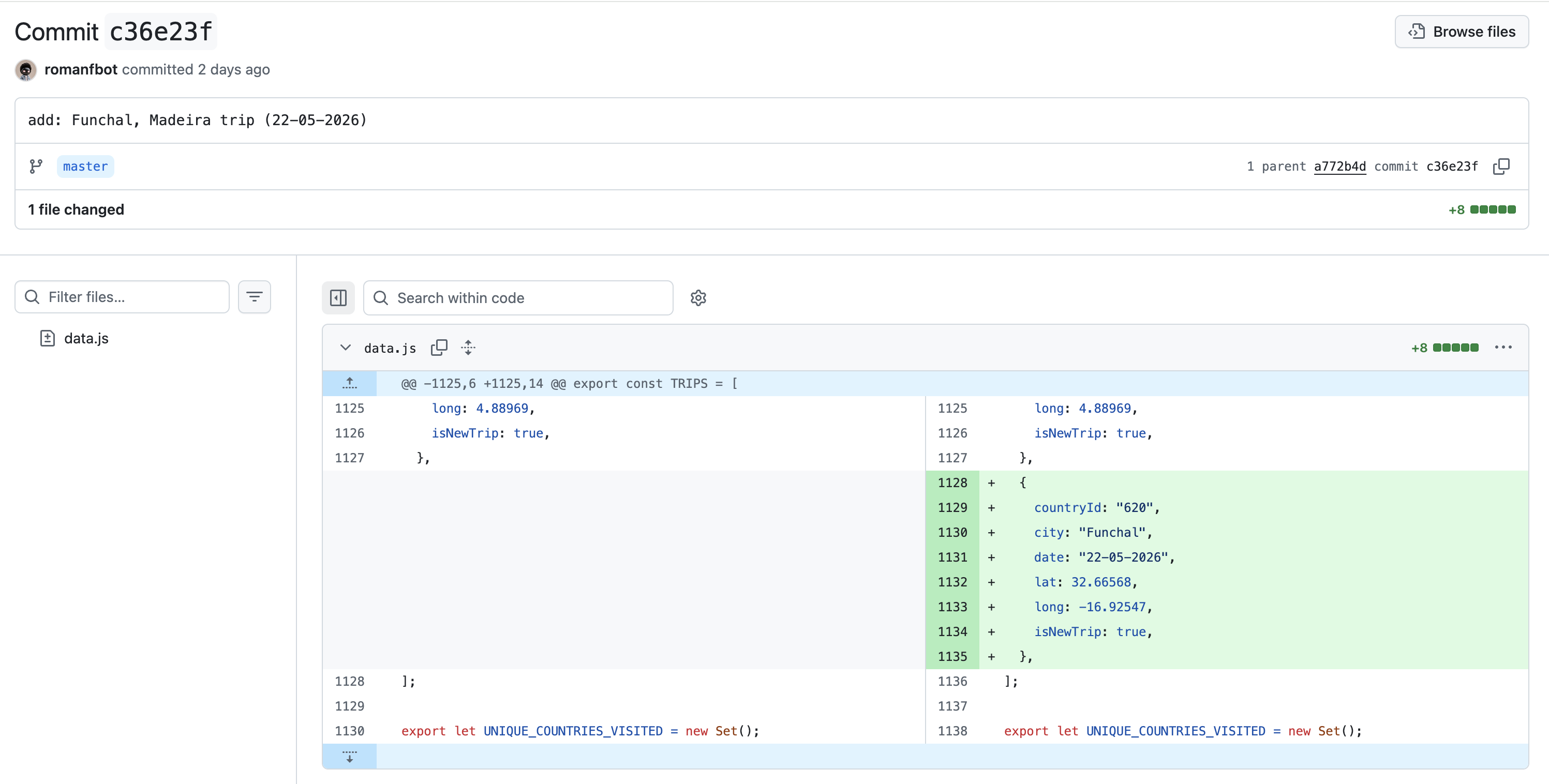
I have a travel log page on this website. Originally, I was updating it manually. Then, when AI became more and more popular, I started using Codex to generate the code changes for me. Now the whole flow is almost fully autonomous.
I send a message to my Telegram chat with the bot, something like:
Update the website, I went to Madeira on May 22
The agent updates the code, creates a commit, pushes it to GitHub, and the website gets updated automatically. Just one message in Telegram, and that’s it.
Email communication
I also used my bot to handle email communication.
One example was a latte art master class that had to be booked manually by email. Instead of writing back and forth myself, I asked the bot to handle it. The agent was not doing anything impossible. It was just email communication. But it was nice to offload it and see if it managed to do it.
What did not work: trip planning
For the Madeira trip I mentioned earlier, I tried to use my bot and ChatGPT’s deep research mode to create an itinerary. At first glance, the result looked nice and useful. Just look at this website created by my agent:
https://romanfbot.github.io/madeira-trip/
But in reality, it wasn’t that useful. It planned hikes in completely different parts of the island on the same day, didn’t clearly tell me that some hikes had to be booked in advance, and some trail recommendations were not that great.
I think this can be improved with better guidance, custom skills, and more structured workflows. For example, the agent should probably understand driving distances, required reservations, trail difficulty, parking, weather, and backup plans. I’ll give it another try next time.
What did not work: learning French
Another area where I tried many things is learning French. I have to admit, I probably should have spent more time actually learning the language instead of creating apps or improving the way I learn it 😅
My first attempt was to use OpenClaw as an AI French tutor, and at first it worked quite well. Compared to regular ChatGPT or Claude, OpenClaw had a much more transparent explanation of how memory worked, so I could create a better workflow for generating engaging, non-repetitive exercises, having conversations, and practicing French.
For example, ChatGPT used to constantly create the first exercise where the correct answer was imparfait. I’m not sure how it works now, but back then it felt like memory was very limited. It didn’t really understand what I had already practiced, what mistakes I made, and what should come next. With OpenClaw, I had more control over this workflow.
At some point, I even tried to turn it into a product and created LexieBot. Unfortunately, Telegram didn’t allow me to advertise it on their platform, so I didn’t get many users. I got a few from Google Ads, but none of them converted into paying users, so I gave up. Anyway, it was a fun experiment. Probably a separate topic for another post.
I also have private French lessons, and I use Granola to keep meeting notes. At one point, I asked an LLM to analyze all the transcripts, identify my most common mistakes, and create a short report. The insights were useful. I can’t say there was anything truly surprising, but I did start paying more attention to these mistakes when speaking French.
I also asked Codex to create a small website with an overview of my mistakes and some exercises based on them. It was cool to see once, but I never opened this website again.
That might still sound pretty great, so why do I say that it didn’t work? Because despite all these experiments, I still haven’t found a workflow that helps me learn French consistently. AI can generate exercises, explain grammar, analyze mistakes, and create study plans, but the hard part is still the same: creating a plan that actually works, making it engaging enough to stick with, and building real commitment to follow it consistently.
So, is personal AI assistant actually useful?
Are these automations game-changing? Not really.
Can many of these things be done without Hermes, just in ChatGPT or Claude? Yes, absolutely.
Do you actually need an LLM for this? No — many tasks are faster and cheaper to complete “the old way.”
The main value for me is not that I automated one specific task. The main value is that I can experiment with new tools, try different workflows, better understand the current capabilities and limitations of AI agents, and use this experience to find actually useful use cases.
I started automating some routine tasks at my job too: building small internal skills, preparing recurring reports, and sharing them with colleagues. One example is my “morning routine” skill, which checks my calendar for meeting conflicts and summarizes messages from important Slack channels. Another example is a skill that prepares a monthly reliability analysis, which used to take quite a lot of time to do manually. Also, because of my personal AI assistant experiments, I discovered agent-browser and later suggested that my colleagues give it a try.
I also started to look at coding agents differently. In real production projects, there is existing code, technical debt, changing requirements, and many constraints, so vibe coding does not work as magically as some examples on X or in podcasts suggest.
At the same time, when you work on side projects, you have almost no limitations. As soon as you start experimenting, you quickly see what modern coding agents are capable of, and you probably start wishing you could work the same way on your main projects at your job.
Final thoughts
So, should you install Hermes, OpenClaw and build your own AI agent?
If you’re a technical person, have some free time, and want to better understand what current LLMs can and cannot do, then yes — I think it’s absolutely worth trying. Set up Hermes, OpenClaw, or whatever personal AI agent framework looks interesting this month. Rent a cheap VPS, give it access to a few low-risk accounts, automate something small, and see where it succeeds and where it falls apart.
You’ll learn much more by actually using these tools than by reading threads on X or listening to podcasts. The biggest benefit is not the automation itself, but developing an intuition for the real capabilities and limitations of modern AI systems.
Do you have to do it? Not really.
If your goal is simply to get things done, there’s a good chance that most of these capabilities will eventually appear directly inside ChatGPT or Claude natively. The setup, maintenance, and experimentation take time, and for many people, it makes more sense to wait until the experience becomes more polished and easy to use.